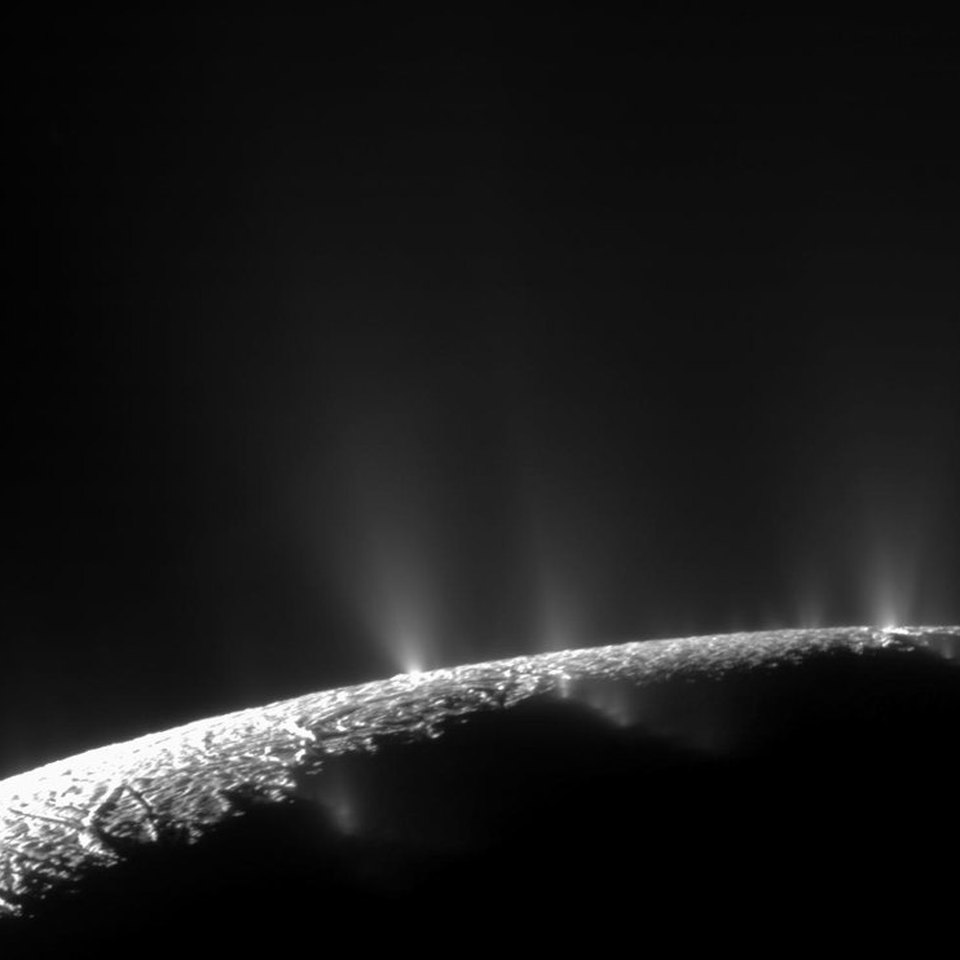
Geysers on Enceladus – Cassini
Photographed in 2009 by NASA's Cassini spacecraft with the Sun behind the moon. Jets of water ice erupt from cracks near Enceladus's south pole, fed by an ocean under the ice, and Cassini later flew straight through them.
Real, or AI slop?
The story
Until NASA’s Cassini spacecraft arrived at Saturn, tiny Enceladus — only about 500 kilometres wide, roughly the width of Great Britain — was expected to be a frozen, geologically dead snowball. Instead, in 2005 Cassini spotted towering plumes of water vapour and ice crystals shooting into space from four warm parallel fractures near the moon’s south pole, nicknamed tiger stripes.
By photographing the moon nearly head-on into the Sun’s glare, Cassini’s cameras lit up dozens of individual jets erupting from a salty liquid ocean hidden beneath the ice crust.
Good to know
- Ice grains blasted out of Enceladus feed Saturn’s diffuse outer E ring, meaning the moon is literally painting a ring around its planet.
- Cassini later flew directly through the plumes and detected water, salt, silica nanograins, molecular hydrogen and simple organic compounds.
Background written with Claude (Opus 5.5) from public sources.