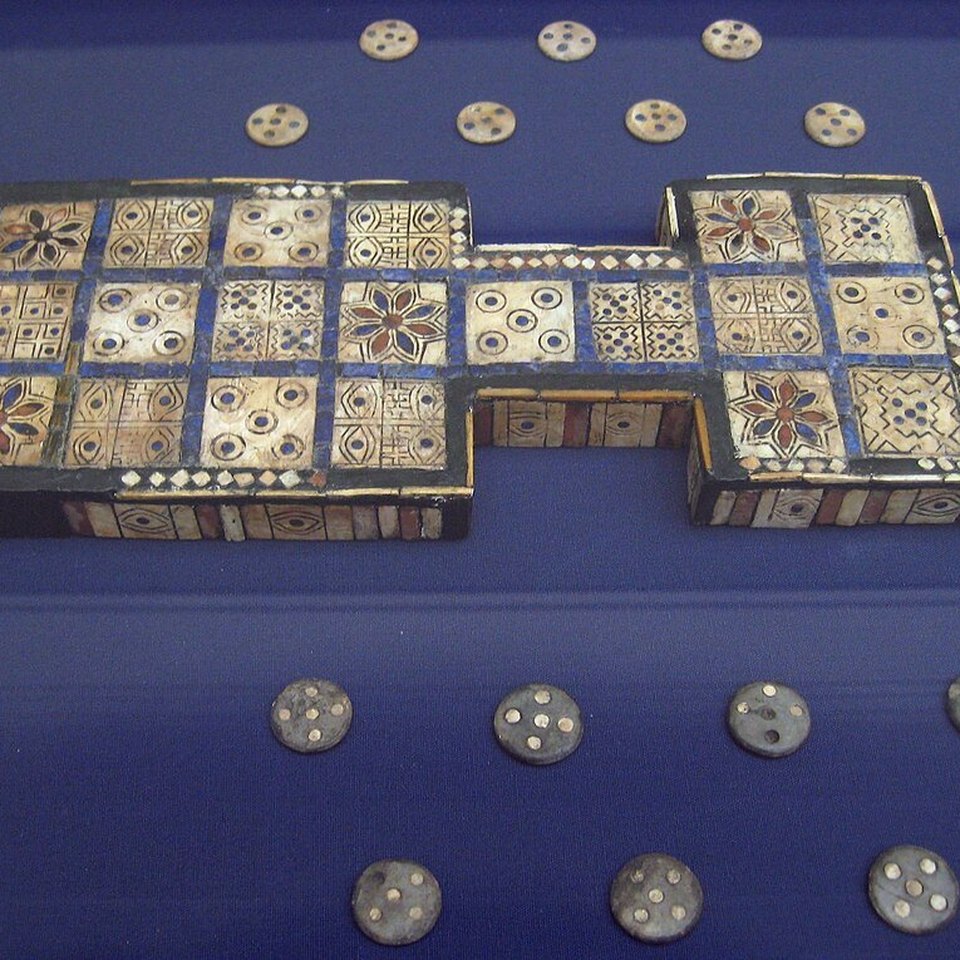
The Royal Game of Ur
A race game about 4,500 years old, found by Leonard Woolley in the Royal Cemetery at Ur in southern Iraq in the 1920s. Its rules were worked out from a Babylonian clay tablet, and the board is now in the British Museum.
Real, or AI slop?
The story
The Royal Game of Ur is about 4,500 years old. Boards like this one were found in the 1920s in the Royal Cemetery of Ur, in what is now southern Iraq, by the archaeologist Leonard Woolley. This board, decorated with shell, red limestone and lapis lazuli, is in the British Museum.
It’s a race game for two players, a bit like backgammon: each player moves pieces along a track, using pyramid-shaped dice, and can knock opponents’ pieces off the board. Landing on a rosette square gives an extra turn.
How do we know the rules? A Babylonian clay tablet from much later, around 177 BC, describes how to play. Irving Finkel, a curator at the British Museum, worked out the rules from it, and the game is now played again, online and with homemade boards.
Good to know
- The game was played across the ancient Middle East for thousands of years.
- A version survived into the 20th century among the Jewish community of Kochi, in India.
- Finkel’s video playing the game against the YouTuber Tom Scott made it famous again online.
Background written with Claude (Opus 5.5) from public sources.